

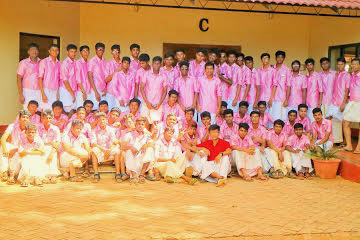
ELANGO DINESH has been with Grail Trust since he was a small boy aged 9 or 10, when he studied at VI Standard. His parents had both died and Elango was subsequently cared for by his uncle.
A very bright boy, he won a scholarship place to King’s School, the English-language private school in Pudhur near our village of Chinnammalpuram. Grail Trust supported him for 12 years and he has rewarded our hope in him by graduating this month with first class honours in Bachelor of Science (Physics) at Tirunelveli, the nearest city which he has commuted to daily for three years.
He has done extremely well, after a difficult start in life. He hopes to become a Civil Service Administrator or Collector, as it is called in India ie the Indian Administrative Service (IAS). His plans are to go Chennai to train for the United Public Services Commission (UPSC) and he hopes to serve his community in government service.
Elango moves on to the next step with all our good wishes.
He has emailed a letter to Chairman Neil Fairlamb to thank all who supported him via Grail Trust UK.
Elango writes:
Dear Uncle,
Greetings of the day. I am Elango Dinesh, student of Grail Trust (india) Chinnammalpuram. I will be completing my college studies by June 26, as my final semester examinations are going on . I thank you and the trust so much for the help and support in my studies.
Thanking you!
Yours sincerely,
P. Elango Dinesh.
N.B. Group photo: The young men in this photograph with Elango Dinesh are wearing DHOTIS. The dhoti is a type of sarong, tied in a manner that outwardly resembles “loose trousers“.It is a lower garment forming part of the national or ethnic costume for men in the Indian subcontinent. The dhoti is fashioned out of a rectangular piece of unstitched cloth, usually around 4.5 metres (15 ft) long, wrapped around the waist and the legs and knotted either in the front or the back. Dhotis come in plain or solid colours, silk dhotis with embroidered borders are considered to be formal wear. The dhoti is touted as the male counterpart of the sari worn by females to religious and secular ceremonies (functions). (With thanks to Wikipedia!)
